Thailand is known around the world as the Land of Smiles. It’s a slogan you’ll see on tourist posters rather than hear from a Thai person, but there’s real truth in it. What the slogan doesn’t tell you is how much is going on behind those smiles, and how much of it works completely differently from back home.
I’ve lived in Thailand for over three years now. I taught here for a year before settling, and these days I’m tucked away in Fang, up in the mountains of Chiang Mai. In that time I’ve picked up a good amount of Thai language skills and a few better habits, and I’ve also got more than my fair share of things wrong. Every one of those mistakes taught me something about how Thai culture ticks.
So this is the post I wish I’d read before I arrived. It’s written mainly for anyone thinking of teaching here, but if you’re simply curious about how Thai and Western culture differ, pull up a chair. One quick caveat first: these are generalisations, and Thailand is a big, varied country full of individuals. Treat what follows as a map, not a rulebook.
1. Face / หน้า / “naa”
If there’s one idea to get your head around before stepping into a Thai classroom, it’s face. Face is your standing and dignity in other people’s eyes, and everyone here is quietly looking after both their own and everyone else’s.
That means no public criticism, no public correcting, and no open disagreement. Point out in front of a room that a colleague has made a mistake, however politely and however right you are, and you haven’t just fixed a problem. You’ve embarrassed them, and that can damage a relationship for good. Feedback in Thailand tends to be private and indirect, sometimes passed along by a third person, and often wrapped in praise. Back home, directness is usually read as honesty. Here, it can come across as aggression.
At school, and in your community, this matters enormously. If there’s an issue with a student, a co-teacher or the school itself, a quiet word in private will get you much further than taking a stand in public.
It seeps into personal life too, and this is where I learnt the hard way. I’m a say-it-straight-away sort of person, whether it’s with a friend, a partner or a restaurant server who’s brought the wrong dish. Many Thai people would rather let something go than raise it, and when that’s combined with consideration for others (more on that shortly), small issues get quietly bottled up. They don’t disappear, though. I’ve seen it with my Thai girlfriend, and I’ve heard the same story from plenty of others: the tiniest thing can suddenly set off ten other things from the past month, all seemingly unrelated, and every one of them something that could have been dealt with there and then.
The lesson for a straight talker like me is to learn to spot the small signs early, and to make it easy for the other person to bring things up before they pile up.
2. Cool Heart / ใจเย็น / “jai yen”
The Thai phrase is jai yen (ใจเย็น), a cool heart. Its opposite, jai ron (ใจร้อน), a hot heart, is something you really don’t want to be accused of. Staying calm and even-tempered is a core virtue here. Raised voices, visible anger, and open frustration suggest you’ve lost control, and with it, other people’s respect.
Once you start looking, you see it everywhere. I almost never witness road rage, which, if you’ve ever sat in traffic on the M25, feels close to witchcraft. People are easy-going and calm even when things get properly stressful. I’ve seen it first hand during a flood, where patience and composure were the order of the day.
That constant smile is part of it too. Westerners often read a smile in the middle of a problem as insincerity, or as not caring. It almost never is. It’s usually about keeping things smooth and everyone comfortable.
For teachers, the takeaway is simple: whatever happens in the classroom, the staffroom or the school office, take a breath and keep your cool. Losing your temper is the quickest way to lose respect.
3. Hierarchy / อาวุโส / “a-wu-so”
In the UK, we like to flatten things. You call your boss by their first name, you’re encouraged to challenge ideas in meetings, and everyone’s opinion supposedly counts the same. Thailand doesn’t work like that.
Status here runs through age, job title, wealth, and education, and it shows up in dozens of small ways. It’s in the wai, the traditional greeting with palms pressed together, where who goes first and how high your hands rise depend on who’s who. It’s in the language, from polite particles to kinship terms like pi (พี่) for someone older and nong (น้อง) for someone younger. It’s in who sits where and who speaks first at a meal or a meeting.
As a teacher, you’ll find you’re treated with real respect, and you’re expected to return the favour to those above you, whether that’s a head teacher, a director or a much older colleague. Don’t assume your opinion will be treated as equal just because it’s well argued. Learn the order of things first.
At the very top of that order sits the monarchy. The royal family is deeply revered and sits above everyone else. Criticising it is not only taboo, it’s illegal under the lèse-majesté law, so this is one topic where the safest policy is to say nothing, even as a joke.
4. Consideration / เกรงใจ / “kreng jai”
This one is kreng jai (เกรงใจ), and it’s famously tricky to translate. The closest I can get is a deep reluctance to impose on, inconvenience or burden anyone else, so you hold back what you want or need for the sake of the other person.
In practice, people will tell you “it’s fine” or “mai pen rai” when it isn’t. They won’t ask for help, and they very rarely say no directly. A “yes” can simply mean “I’ve heard you” rather than “I agree”, and you’re often left reading what isn’t being said.
This is especially important at work. A colleague might be unhappy about a change, a request or a plan, but won’t tell you. Learning to read the room is a real skill here: watch for hesitation, a long pause, a change of subject, or an overly polite answer. And if you need an honest answer, offer choices instead of yes-or-no questions, and make it easy for people to say what they really think without losing face.
5. Never Mind and Fun / ไม่เป็นไร และ สนุก / “mai pen rai” and “sanuk”
If there’s one phrase you’ll hear more than any other, it’s mai pen rai (ไม่เป็นไร): never mind, it’s okay, don’t worry about it. It’s a shrug at things going wrong, and it’s often mistaken for carelessness. It isn’t. It reflects acceptance and flexibility, a quiet understanding that getting upset rarely fixes anything.
Its partner in crime is sanuk (สนุก), or fun. Thai people expect work, and tasks in general, to carry at least a little enjoyment. Heavy seriousness can feel off-putting, and an atmosphere with some laughter in it is usually a sign that things are going well, not that people aren’t working.
Honestly, this is one of my favourite parts of Thai culture. As a teacher, it’s also a gift. Lessons with games, laughter, and a bit of silliness tend to land far better than anything stiff, and when the photocopier packs in or the timetable changes, you’ll learn to shrug and carry on, just like everyone else.
6. Karma and Merit / กรรมและบุญ / “gam” and “bun”
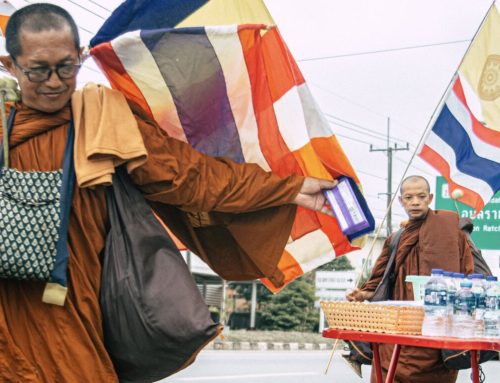
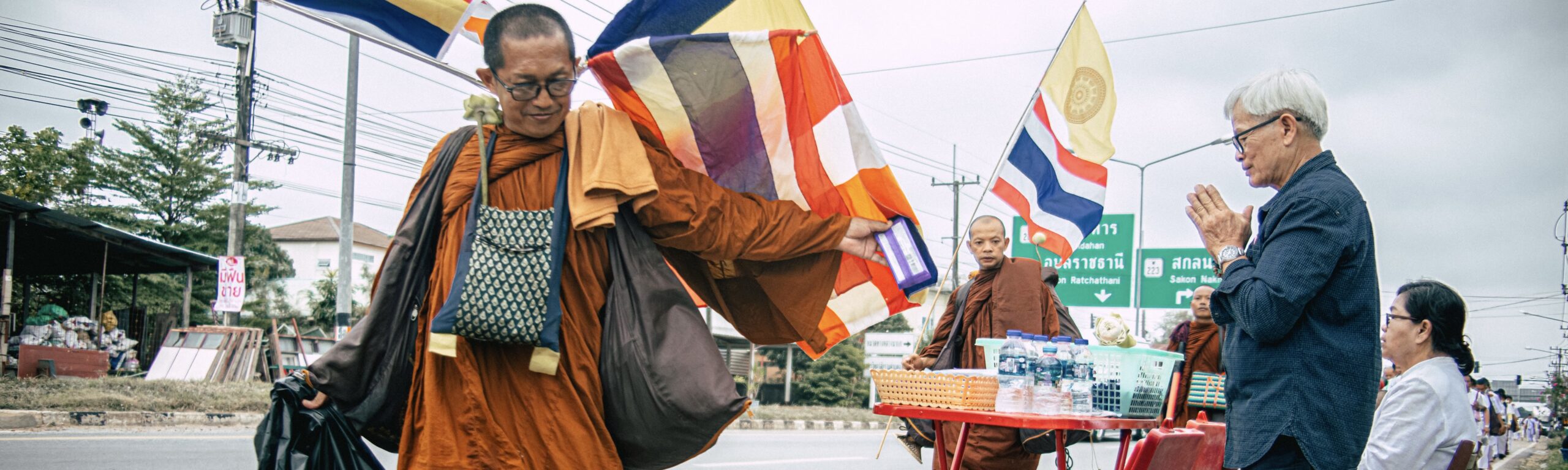
Buddhism shapes daily life in Thailand far more than most you might expect. Merit-making is a normal part of the week, monks are treated with great respect, and there’s a widespread belief that the circumstances you’re in reflect what you’ve done before, in this life or another.
It can also throw up some puzzling moments. I’ll admit that I find it a little hypocritical when someone buys live fish to release into a lake for good karma, then heads off to lunch and orders fish. But that’s how it is, and I’ve learnt to leave my Western logic at the door. The merit comes from the act and the intention, and it’s not my place to judge.
My advice is to appreciate it rather than pick it apart. Spend a bit of time trying to understand why people do what they do, and you may even find there’s something to learn from it.
7. Heads and Feet / หัวและเท้า / “hua” and “tao”
In Thailand, the head is sacred and the feet are the lowest part of the body, and that simple idea explains a surprising number of rules. Don’t touch people’s heads, and that includes patting a child’s head in the classroom, however friendly the intention. Don’t point your feet at people or at Buddha images, and don’t step over people or food.
It sounds like trivia until you get it wrong. Picture the scene in your local 7-Eleven. Your hands are full of snacks after you’ve just grabbed a bottle of pop from the fridge, so you nudge the fridge door shut with your foot. Normal, right? Nobody will say a word, of course (see: face), but the glaring eyes will make the message loud and clear.
It’s an easy habit to pick up, and worth learning early. Keep your feet on the floor, never on a desk or a chair, and always use your hands.
8. Last-Minute Plans / แผนกะทันหัน / “paen ga-tan-han”
British people love a plan. Diaries get filled weeks ahead, and a change of date can feel like a minor crisis. In Thailand, schedules are far looser, last-minute changes are routine, and holidays are often announced with very little warning.
I’ll be honest, it’s hard to accept at first, because we’re so used to knowing what’s coming. But it’s worth understanding why. It links back to hierarchy: decisions tend to be made higher up and passed down, and the people at the bottom of the chain, which is often us teachers, simply adapt. It’s less about disorganisation and more about a different way of ordering the world, one where relationships and flexibility matter more than deadlines.
The best approach is to hold your plans lightly. Confirm things more than once, politely, which is perfectly normal here, and try not to commit to anything non-refundable until you’re sure it’s happening. You’ll have far more fun, and far fewer grey hairs, if you learn to go with it.
9. Togetherness / ความสามัคคี / “kwaam saa-mak-kee”
Western culture celebrates the individual: personal achievement, personal goals, personal rights. Thai culture leans the other way. Group harmony, family obligations, and personal networks (who you know and who vouches for you) often matter more than individual success or even the rules on paper. Relationships tend to come before business.
It isn’t always obvious on the surface, but spend long enough here and you’ll notice that people are far more motivated by the we than the I. Children look after their parents. Communities rally round one another in times of need. Success is something you share.
In the classroom, that’s worth remembering. Team activities and group games usually go down far better than singling one child out, which, as we’ve seen, risks a loss of face. Play to the group and you’ll have the whole room with you.
10. Modesty / เรียบร้อย / “riap-roi”
Put simply, PDA is not a thing in Thailand. Even couples show very little affection in public, so don’t expect hand-holding to be on show, let alone anything more. Hugging or touching someone you’ve only just met is a no-no, and a wai or a smile is a much safer way to say hello.
Modest dress is expected too, especially around temples and in rural areas, and teachers are generally expected to dress smartly and conservatively at school. Pack accordingly, and you’ll save yourself a few awkward moments.
Final thoughts
None of these differences make Thai culture better or worse than ours. They simply make it different, and that’s exactly what makes living here so fascinating. You’ll misread a smile, put your foot in it (not literally, I hope), and get caught out by a last-minute holiday. Then one day it all starts to click, and you realise some of these habits are ones you’d quite like to take home with you.
Teaching in Thailand is one of the best ways to experience that first hand, with a classroom full of students, a staffroom full of colleagues, and a country full of things to learn.
Have a look through our Thailand program page for locations, salaries, and start dates, or email us at info@impact-teaching.com if you’d like to talk through which placement would suit you best.