
By Arnold Vis
We’ve recently started working with a new private school partner in Beijing, and it’s a placement I’m particularly excited about.
That’s because it’s a job that offers a high salary (£2000 per month, which is $2700) with lots of potential to save money, which is available to teachers without teaching experience.
As we have recently expanded and offer lots of placement opportunities in a number of countries, I’ve realised that this kind of opportunity is rare.
When I worked in China, I worked at a training centre myself, and I had a great time.
In this blog post I’ll review some key aspects of working at a training centre.
Disadvantage
Working hours: at a training centre, you are off on Monday and Tuesday. On Wednesday, Thursday and Friday you come in around 1pm to do lesson prep in the office. The students then arrive for classes around 5:30pm, and you teach till 8:30pm/9pm. On Saturday & Sunday, you teach full days between 9am and 5pm.
I’ve classed this as a disadvantage because in my experience it divides opinion. Quite a lot of candidates I speak to aren’t keen on it, but many others prefer it because they have freedom in the mornings and can join courses and study a language etc.
Advantages
Salary: as mentioned above, the salary you earn is high given the cost of living in Beijing, and enables you to save. According to Numbeo, the cost of living in Beijing is 60% lower than in London, and 68% lower than in New York. I often talk to candidates that look for an exciting TEFL job abroad that enables them to live comfortably and also regularly send money home. This opportunity enables you to do just that.
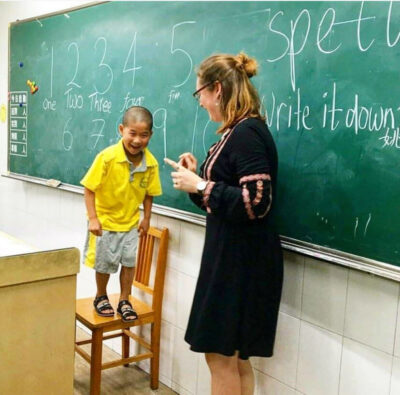 Motivated students: at a training centre, you work with classes of 10-15 students aged 6-16 years old. Students come to the centre in the evening after school and on weekends, and their parents pay for them to be there. This means there is a specific reason they want to learn English. Often it’s to have the the option of studying abroad given how competitive the Chinese university entrance exam is. Every child is different and ultimately motivation levels will vary, but in general it means considerably more focus and motivation than at a state school.
One example that stands out in my mind is a 9- year old girl who attended one of my assemblies at my training centre. After the session, she stopped me to say she was going to study at Harvard. It was so striking that a 9 year old had such a specific plan, and all the more so when she found me on social media a decade later to announce she was now studying in the US! It was amazing, and a reminder of the drive and focus on education that’s prevalent in China. Being part of that is a wonderful and fulfilling experience.
 Colleagues and management
Training centres tend to employ a team of 10-15 teachers, and our partner in Beijing has multiple branches in the city. This means that from the moment you arrive, you are part of a team of people in the same boat as you. It really helps to have a group of people to have meals with, hang out with and lean on. As Sunday night is the last day of the work week, it’s often a standing night out for a meal and a drink as a group.
The management and work culture at a school like this feels like a hybrid between a Chinese workplace and a western one, with your line manager often being a fellow foreign teacher with lots of experience in China and at the school.
This limits the culture barrier and workplace misunderstandings and it tends to work well. The one downside in this is that it’s an environment that’s less conducive to learning Mandarin than being in a more authentically Chinese workplace.
The curriculum
Training centres are a competitive industry in China with the aim of getting students comfortable with speaking English and being around foreigners, and potentially moving abroad.
As such the curriculum has been designed accordingly, and it’s fun. You tend to use the textbooks for about two thirds of your class time, and for the remainder of the time, you have the chance to play games, or have class debates.
Teenagers going to private training centres will have studied English for a long time, and their English is at a conversational level. As such this can lead to fun and stimulating exchanges, and it won’t take long for you to get to know all your students well given the small class sizes.
I hope this has helped paint a picture of life at a training centre in China!
I had a blast working there and if it sounds good to you too, we’d love to hear from you. You can apply here.
Feel free to email me if you have questions: arnold@impact-teaching.com